The Core Divide in Grooming Technology
When transitioning to an electric grooming routine, the most fundamental decision you will face is choosing between a rotary shaver and a foil shaver. These two distinct technologies approach the task of hair removal using entirely different mechanical principles. Understanding how each operates is crucial for selecting a device that aligns with your specific skin type, hair growth patterns, and daily routine.
At their core, both systems use a protective metal barrier to shield the skin from direct contact with sharp moving blades. This barrier captures the hair, allowing the blades beneath to slice it cleanly. However, the shape of this barrier and the motion of the underlying blades dictate the performance characteristics of the shaver.
The Mechanics of Foil Shavers
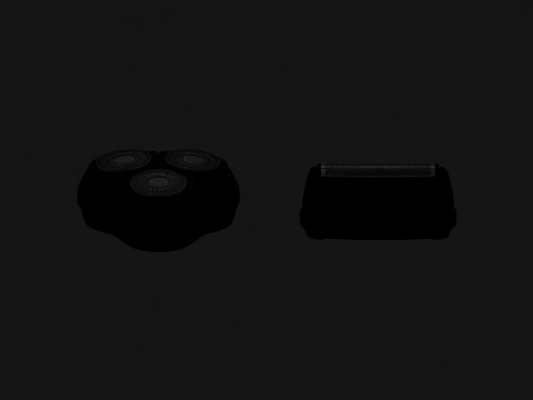
Foil shavers utilize a thin, curved metal mesh—the "foil"—that covers a set of oscillating cutting blades. These blades move back and forth at incredibly high speeds (often exceeding 10,000 micro-vibrations per minute in premium models) inside the foil housing. As you glide the shaver over your skin in straight lines, hair feeds through the microscopic holes in the mesh and is sheared off by the linear motion of the cutter block.
Advantages of the Foil System
- Closeness: Because the foil can be manufactured extremely thin, the distance between the cutting blade and the skin is minimized, resulting in a remarkably close shave that approaches the feel of a manual razor.
- Precision: The straight-line operation and rectangular head make it much easier to define sharp edges, such as sideburns or the borders of a goatee.
- Skin Comfort: For users with delicate epidermis, foil models are generally less abrasive. The rapid linear motion rarely pulls or tugs at the hair, provided the shaving stroke goes against the grain in straight, controlled passes.
The Mechanics of Rotary Shavers
In contrast, rotary shavers typically feature three (or sometimes four) circular heads arranged in a triangular pattern. Each head contains a spinning disc of angled blades situated beneath a slotted metal guard. The design is intended to conform to the three-dimensional geometry of the human face, particularly around the jawline, chin, and neck. Users operate rotary shavers using circular motions rather than straight up-and-down strokes.
Advantages of the Rotary System
- Contour Adaptability: The individual heads of a rotary device can flex, pivot, and tilt independently. This articulation allows the machine to maintain constant contact with heavily contoured areas like the adam's apple or a pronounced jawline.
- Handling Wild Hair Growth: If your facial hair grows in multiple, unpredictable directions, the circular motion of a rotary head excels at catching hairs that a linear pass might flatten against the skin.
- Thick Hair Management: Rotary mechanisms are generally more forgiving of longer hair. If you shave infrequently (e.g., every three or four days), a rotary shaver is less likely to bog down or require pre-trimming.
Making Your Decision
Choosing between these two technologies largely depends on your personal biology and habits. If you shave every day, possess relatively straight hair growth, and prioritize the smoothest possible finish and sharp lines, a foil mechanism is mathematically and mechanically optimized for your needs.
Conversely, if your routine is sporadic, your facial hair is dense and grows in whorls or unpredictable angles, and you struggle to navigate the sharp angles of your jawline, the flexible, multi-directional nature of a rotary device will likely yield a more efficient and less frustrating experience.
Ultimately, both technologies have benefited from decades of refinement. Advances in material science, such as titanium coatings and hypoallergenic metals, mean that a high-quality model from either category will provide a vastly superior experience compared to the electric tools of the past.